Many delivery companies still plan routes manually — using local knowledge, gut feeling, and spreadsheets. It works, until it does not. As delivery volumes grow and customer expectations tighten, the gap between manual planning and automated ruteoptimalisering becomes a serious competitive disadvantage. This article breaks down the real costs of both approaches so you can make an informed decision.
Automated route optimization costs less than manual dispatch once a fleet passes roughly five vehicles. Manual planning takes a dispatcher 2-3 hours every morning, and the routes it produces are typically 15-25% longer than optimized ones — so the saving lands twice, in planning time and in fuel and driving hours. Below five vehicles, with stable repeating routes, manual planning is still defensible. Above it, the gap widens with every vehicle you add.
By Nora Rieber-Mohn, founder of Zoopit. Last updated 9 October 2026.
Manual Planning vs Route Optimization: Side by Side
| What you are comparing | Manual planning | Optimalisering av ruter |
|---|---|---|
| Time to build a day’s routes | 2-3 hours every morning | Minutes, and it can run on a schedule |
| Route length | Baseline | 15-25% shorter |
| Total driving distance | Baseline | 20-30% lower |
| Deliveries per driver per day | Baseline | 15-25% more |
| Constraints applied at once | As many as one planner can hold in mind | Hundreds, applied simultaneously |
| Multi-depot decisions | Judged case by case | Rules bound to named hubs |
| Fleet sizing | An annual average, estimated | A requirement per day and per depot |
| When the dispatcher is away | The route knowledge goes with them | The rules stay in the system |
| Direct cost | No licence fee | A licence fee, set against fuel and driver hours |
What Manual Ruteplanlegging Actually Costs
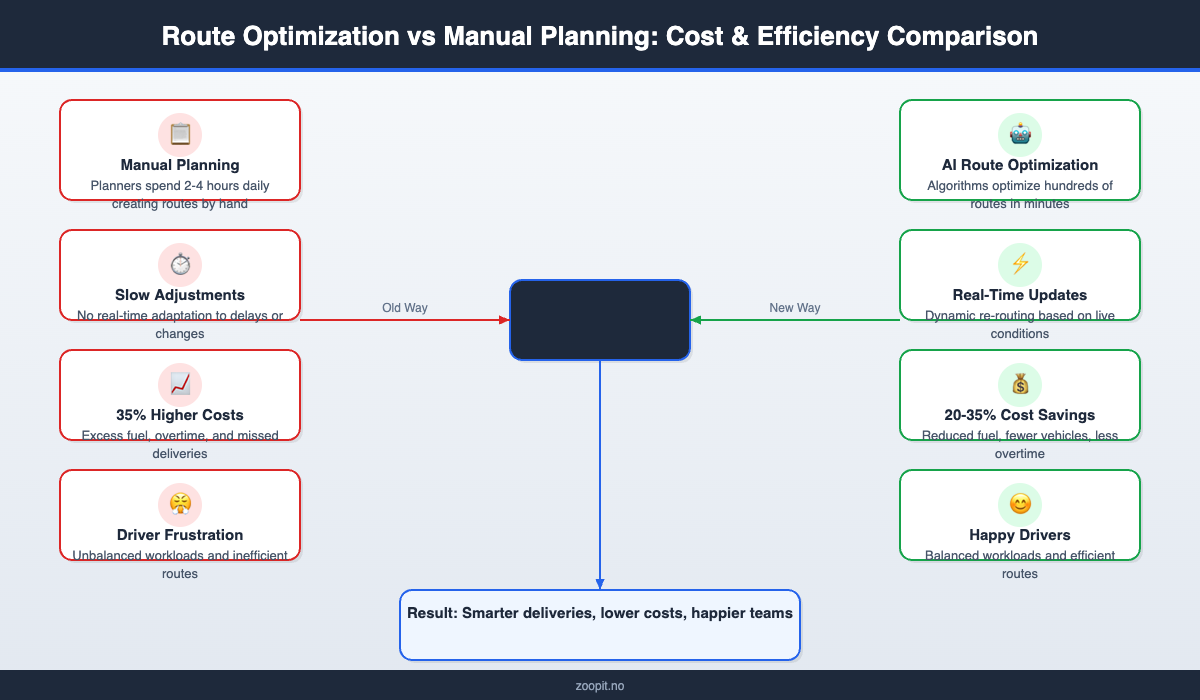
Manual planning looks cheap because there is no software to buy. The cost is real, it is just paid somewhere else: in the dispatcher salary spent on a task software does in minutes, and in routes that run longer than they need to. Both halves scale with the fleet, which is why the number nobody is tracking grows quietly.
Tenk deg en flåte på 10 sjåfører som utfører 150 leveranser per dag. Hvis manuelle ruter bare legger til 20 minutter unødvendig kjøring per sjåfør, blir det over 3 timer bortkastet kjøretid daglig for hele flåten. Med gjennomsnittlige europeiske drivstoff- og lønnskostnader utgjør dette rundt 200-400 euro per dag i unødvendige utgifter - eller 50 000-100 000 euro per år.
Hva programvare for ruteoptimalisering leverer
Programvare for ruteoptimalisering tar hensyn til hundrevis av variabler samtidig: trafikkmønstre, tidsvinduer for levering, kjøretøykapasitet og -type, sjåførenes arbeidstid, veirestriksjoner, rekkevidde for elektriske kjøretøy og kundeprioriteringer. Ingen menneskelig planlegger kan håndtere så mange begrensninger samtidig, spesielt ikke under tidspress klokken 06.00 om morgenen når rutene må være klare før sjåførene ankommer.
The results are consistently measurable. Companies switching from manual to optimized planning typically see four changes:
- 20-30% less total driving distance. The same stops, served in a better order, from a better starting assignment.
- 15-25% more deliveries per driver per day. Time saved on the road becomes capacity, not idle time.
- 30-50% less time spent on daily planning. The dispatcher moves from building routes to handling the exceptions that actually need judgment.
- Fewer late deliveries and missed time windows. Time windows are a hard constraint for the optimizer rather than something a planner has to remember.
What Is Constraint-Based Route Optimization?
Basic route optimization plots the shortest path between stops. Advanced platforms go much further by matching orders to vehicles based on real operational constraints. This means the system automatically considers details like whether a delivery requires a vehicle below a certain height for an underground loading dock, whether the axle weight limit at a delivery point restricts which trucks can go there, or whether an electric vehicle has enough range for a specific route. Constraint-based optimization makes these rules systematic and reliable instead of personal.
What Is the Difference Between Manual, Automatic, and Hybrid Planning?
Good route optimization software does not force you to go fully automatic from day one. There are three working modes, and most operations use more than one:
- Manual. You select the orders, choose the vehicles, and set the priorities, while the algorithm sequences the stops. Experienced dispatchers keep control and still get the arithmetic done for them.
- Automatic. Routes are generated at a scheduled time from rules you configured earlier. This suits operations with a fixed cut-off and high order volume, where nobody should be waiting on a planner at 6 AM.
- Hybrid. The optimizer produces a first plan and the planner adjusts it — merging, splitting, or reassigning stops before dispatch. This is where most teams land, and it is usually the mode that gets adopted fastest.
Which mode a team can run also depends on what the rest of the operation supports — see how this connects to ekspedisjonsledelse once routes leave the planning screen.
De skjulte kostnadene ved “godt nok”-planlegging
Et argument for manuell planlegging er at erfarne trafikkledere “kjenner rutene”. Og det gjør de - for dagens forhold med dagens kunder. Men hva skjer når den erfarne ruteplanleggeren er syk, på ferie eller slutter i selskapet? Manuell planlegging skaper et enkelt feilpunkt. All rutekunnskapen sitter i hodet på én person, og den blir med vedkommende ut døren.
Route optimization software makes planning institutional rather than personal. Any team member can generate routes, new drivers get optimized navigation from day one, and the operational detail that would otherwise live in one person’s memory — vehicle constraints, customer requirements, access restrictions — is written down where the optimizer can use it.
What Is Tactical Planning, and Why Can Manual Planning Not Do It?
Daily route optimization answers “what should the fleet do tomorrow?” Tactical planning answers a harder question: “how much fleet do we need at all?” It models a representative period — a week, a season, a contract — before any orders exist, using customer addresses, delivery frequencies, and the vehicles you actually run.
The output is a fleet requirement per day and per depot, not a single annual average. That distinction matters, because fleet cost is set by your peak day, not your mean one. A plan that counts trips rather than vehicles is what keeps the number honest: one van running three loads out of the same depot is three trips, not three vans, and a model that cannot tell the difference will overstate what you need to buy.
Multi-depot operations are where manual planning breaks down completely. When a customer can be served from two terminals, the question is not just which route, but which depot — and that choice changes the fleet requirement at both. Tactical planning handles this by binding rules to named hubs, so a customer group that must be served from a specific terminal stays there while the rest of the network balances around it.
The same applies to vehicle type. A fleet is rarely interchangeable: some loads need a tail lift, some need a specific body, some need a driver certification. Modelling vehicle classes and required skills alongside volume is what separates a credible fleet plan from a spreadsheet estimate — and it will tell you when a capacity unit in your data simply cannot be carried by anything you own, which is a finding worth having before a tender rather than after it.
Standing routes fit the same model. Fixed runs that repeat regardless of order volume — a daily hospital delivery, a contracted collection — can be treated as a requirement the plan must satisfy rather than an exception the planner remembers. Manual planning cannot answer any of this, because it only ever deals with today’s orders.
When Should You Switch from Manual Route Planning?
The threshold is roughly five vehicles. Below that, with predictable repeating routes and a planner who knows the area, manual planning can still be the right answer. Once you pass five — or add variable delivery points, customer time windows, or a second depot — the arithmetic turns, and it keeps turning with every vehicle you add.
En Dybdeanalyse av forsyningskjeden shows that route planning inefficiencies account for up to 30% of unnecessary delivery costs. Past about ten vehicles the gap widens again, because that is roughly where a spreadsheet stops being able to hold every variable at once.
How Do You Move from Manual to Automated Planning?
Switching does not have to be all-or-nothing, and the operations that adopt fastest tend to follow the same four steps:
- Run both for a week. Keep planning the way you do now, and let the optimizer plan the same day in parallel. Nothing is dispatched from it yet.
- Compare the two plans on distance and time window compliance. These are the two numbers a dispatcher will argue about, so settle them with the real week rather than a demo dataset.
- Move to hybrid. Dispatch from the optimized plan, but let the planner adjust it first. This is the step where trust is actually built.
- Automate the routine days. Leave the exceptions — new customers, unusual loads, disrupted days — in hybrid mode for as long as you want.
The thing to check when choosing software is that it supports all three modes, because a platform that only runs fully automatic forces the decision on day one. Zoopit lets planners start in manual mode, move to hybrid, and automate daily route generation as confidence grows — and keeps the vehicle and fleet data the optimizer depends on in the same place.
Common Questions
What is the difference between route optimization and manual planning?
Manual planning is done by hand or in spreadsheets and can only consider a limited number of variables. Route optimization software automatically calculates the most efficient routes using all relevant constraints simultaneously.
How much time does route optimization save compared to manual planning?
Most operations see planners save several hours per day when switching from manual to automated route optimization, allowing them to focus on exceptions and customer relationships instead.
What are the hidden costs of manual route planning?
Manual planning leads to longer routes, higher fuel costs, more overtime, and more errors — costs that compound over time and are difficult to spot without route efficiency data.
Is route optimization software worth the investment for small fleets?
Yes. Even fleets with five to ten vehicles typically see a positive return within weeks due to fuel savings, fewer overtime hours, and reduced failed deliveries.
Is automated route planning more cost-efficient than manual dispatch?
For most fleets above five vehicles, yes. The comparison has two sides: the dispatcher hours spent building routes each morning, and the length of the routes that result. Manual routes typically run 15-25% longer than optimized ones, which shows up as fuel, driving hours, and fewer stops per shift. Below five vehicles with stable repeating work, the arithmetic is much closer and manual planning can still be the right answer.
Does route optimization work for scheduled or standing routes?
Yes, and it works differently than for ad-hoc delivery. A standing route — a fixed run that happens whether or not there are orders — is modelled as a requirement the plan has to satisfy, with the vehicle type it needs attached to it. The optimizer then builds the variable work around those fixed commitments instead of treating them as exceptions. This is the common case in scheduled transport — bus and shuttle runs, contracted collections, fixed hospital or retail deliveries — and in any operation where part of the week is already committed before the first order arrives.
What is the difference between route optimization and tactical planning?
Route optimization is operational: it sequences today’s orders across the fleet you already have. Tactical planning is strategic: it models a representative period before orders exist and tells you how much fleet you need, on which days, out of which depots. You use the first every morning and the second when you are pricing a tender, planning a depot move, or deciding whether to add vehicles.
How is AI route planning different from manual planning?
The practical difference is how many constraints can be held at once. A dispatcher balances time windows, vehicle capacity, driver hours, and customer preferences from memory, and does it well for a familiar area. An optimizer evaluates far more combinations than a person can, and applies the same rules on a Monday in January as on a Friday in July. The trade-off is that it only knows the constraints you give it — which is why hybrid modes, where planners can override the result, matter more than full automation.
How many vehicles does my operation actually need?
That is a tactical planning question, and the honest answer depends on your peak day rather than your average. The method is to model a representative week against real customer addresses and delivery frequencies, count trips rather than vehicles, and read the requirement per day and per depot. An annual average will understate the fleet you need; a worst-case day will overstate it.
Er du klar til å gå videre fra regnearkplanlegging?
Zoopit runs automatic optimization when you need speed and full manual control when you need flexibility, with a hybrid mode in between where planners override, adjust, and fine-tune before dispatch.
Book a 20-minute demo og se den reelle kostnadsforskjellen for din virksomhet. Vi kjører en sammenligning side om side ved hjelp av dine faktiske leveringsdata.
If you would rather read first, the programvare for ruteoptimalisering page covers how the planning engine works and what is included.