
Time tracking might seem straightforward, but small time tracking mistakes in how you record driver hours can lead to significant financial and operational problems. Fleet managers who rely on outdated methods or incomplete processes often discover the true cost only when payroll disputes, compliance issues, or scheduling inefficiencies start stacking up.
Here are five of the most common time tracking mistakes in fleet operations, what they actually cost, and how to fix each one.
1. Relying on Driver Self-Reporting
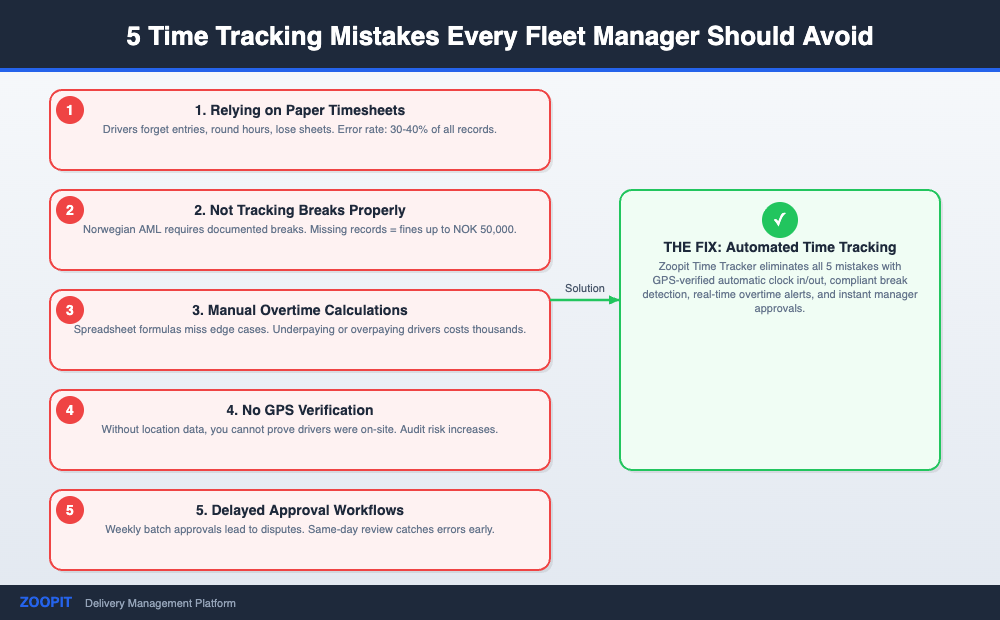
When drivers fill in their own hours at the end of a shift or at the end of the week, the data is unreliable by definition. Not because drivers are dishonest, but because memory is imprecise. A shift that ended at 16:42 gets rounded to 17:00. A late start gets forgotten. Over a month, these small inaccuracies compound into hours of overpayment or underpayment across your fleet.
The fix is automated time capture. When a driver taps to start and stop in an app like the Zoopit Time Tracker, the exact time is recorded without any manual entry. There is no rounding, no estimation, and no room for disputes. This is one of the most impactful time tracking mistakes to eliminate because it affects every single shift.
2. Not Tracking Breaks Separately
Many fleet operations track total shift duration but do not record break times separately. This creates two problems. First, you cannot verify compliance with mandatory rest period requirements under the Norwegian Working Environment Act. Second, you end up paying drivers for break time you cannot account for, or underpaying by assuming breaks were longer than they actually were.
A proper time tracking system records breaks as a separate category. The Zoopit Time Tracker lets drivers tap a dedicated break button, so the system distinguishes between active working hours and rest periods automatically. This data is essential for accurate payroll and for demonstrating compliance with Norwegian labour regulations.
3. Ignoring Overtime Patterns
Overtime is expensive, and one of the most costly time tracking mistakes is failing to monitor it proactively. When you only discover excessive overtime at the end of the pay period, it is too late to do anything about it. The hours have been worked and must be paid.
The better approach is real-time visibility. A dashboard that shows accumulated hours per driver throughout the week lets you intervene before overtime becomes excessive. You can redistribute routes, adjust schedules, or bring in additional drivers before costs spiral. The Zoopit fleet management platform provides this visibility by connecting time data with ruttoptimering, so you can see both where your drivers are spending their time and how to optimize their schedules.
4. Having No Digital Audit Trail
Paper timesheets and spreadsheets offer no reliable audit trail. Entries can be altered, pages can be lost, and there is no way to verify when data was recorded versus when it was submitted. If the Labour Inspection Authority requests your time records during a compliance audit, paper-based systems are difficult to defend.
Digital time tracking creates an immutable record of every clock-in, clock-out, and break. Each entry is timestamped and linked to a specific driver, making it impossible to alter records retroactively. This protects both the company and the driver. It also makes payroll audits and end-of-year reporting significantly faster and more accurate. For the full picture on what Norwegian law requires, see our guide on time tracking compliance for transport companies in Norway.
5. Not Connecting Time Data to Payroll
Even companies that track time digitally often make the mistake of exporting data manually into a separate payroll system. This introduces a new opportunity for errors every pay cycle. Data gets copied incorrectly, overtime calculations are done manually, and discrepancies between the time system and the payroll system create confusion and disputes.
The solution is integration. When your time tracking system feeds data directly into your payroll process, whether through direct integration or clean export files, you eliminate the manual step where most errors occur. The Zoopit Time Tracker provides exportable reports that match standard payroll formats, so the data flows cleanly from the driver’s phone to the payroll team’s system with minimal handling.
The European Parliament’s working time directive requires member states to ensure employers track actual working hours — making these mistakes not just costly, but potentially a compliance risk.
Getting Time Tracking Right
Each of these time tracking mistakes is avoidable with the right tools and processes. The common thread is that manual, fragmented, or disconnected systems create gaps where errors, costs, and compliance risks accumulate quietly over time.
The Zoopit Time Tracker addresses all five of these issues in a single, easy-to-use platform. Automated capture eliminates self-reporting errors. Separate break tracking ensures compliance. Real-time dashboards make overtime visible. Digital records create a complete audit trail. And built-in export functions connect seamlessly to payroll workflows.
Ready to eliminate these time tracking mistakes from your operation? Read our step-by-step guide to getting started, or find out how much manual time tracking is really costing your business.
Eliminate Time Tracking Mistakes for Good
Every mistake on this list disappears when you switch to automatic time tracking. Zoopit’s Time Tracker logs hours from the driver app — no manual input, no forgotten entries, no compliance surprises. It just works in the background while your team focuses on deliveries.
Book a free demo and see how simple time tracking can be when it’s built into your delivery platform.
Explore all Time Tracking features.