
Time tracking compliance is a critical responsibility for transport and delivery companies operating in Norway. Norwegian labour regulations require employers to document working hours, rest periods, and overtime for all employees. For drivers specifically, additional rules around driving and rest times add another layer of documentation requirements that make time tracking compliance even more demanding.
This article explains what Norwegian transport companies need to know about time tracking compliance and how digital tools make it significantly easier to meet these obligations.
What Norwegian Law Requires for Time Tracking Compliance
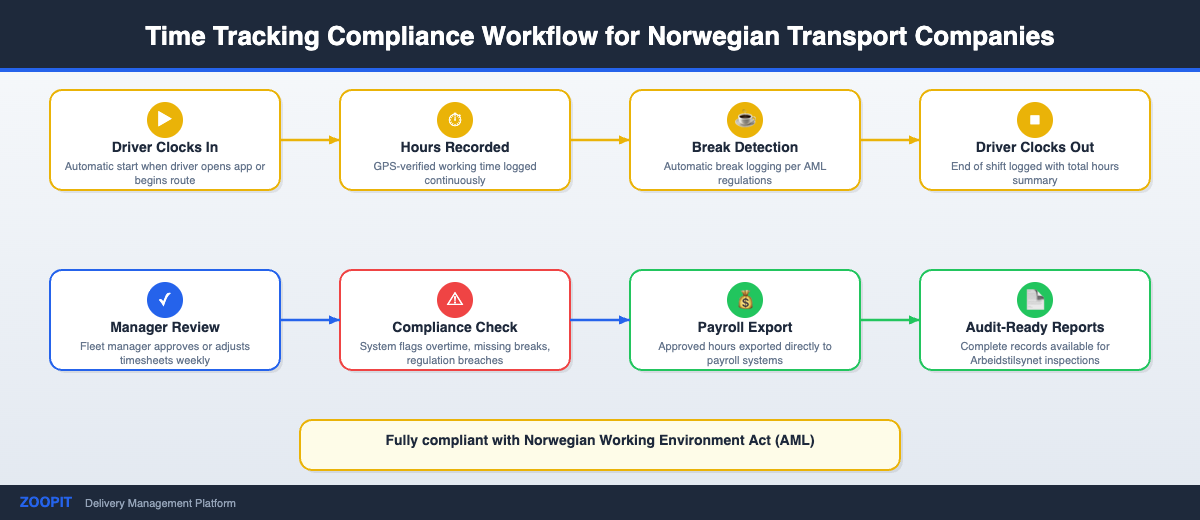
The Norwegian Working Environment Act (Arbeidsmiljøloven) requires employers to maintain a record of working hours for each employee. This includes regular hours, overtime, and any work performed outside normal schedules. The records must be accessible for inspection by the Labour Inspection Authority (Arbeidstilsynet) and must be retained for a specified period.
For transport companies, the requirements are more specific. Drivers who fall under EU driving and rest time regulations must have their hours documented with greater precision. This includes not just total working hours but also driving time, other work, availability periods, and rest breaks. The Arbeidstilsynet guidelines on working hours provide detailed requirements for proper documentation.
5 Key Rules for Time Tracking Compliance in Transport
Understanding the core rules helps you build a reliable time tracking compliance system. Here are the five most important requirements every Norwegian transport company must follow.
Rule 1: Record all working hours accurately. Every minute of driving time, loading, unloading, and administrative work must be captured. The Working Environment Act does not distinguish between types of work – all hours count toward the total.
Rule 2: Document rest periods and breaks. Drivers are entitled to specific rest periods between shifts. Your time tracking system must record when rest periods start and end to demonstrate compliance with both Norwegian and EU regulations.
Rule 3: Track overtime separately. Norwegian law sets strict limits on overtime hours. Your records must clearly distinguish between regular hours and overtime, and flag when employees approach or exceed legal limits.
Rule 4: Retain records for the required period. Time tracking records must be stored and accessible for inspection. The retention period varies depending on the type of record, but employers should plan for at least three years of accessible documentation.
Rule 5: Make records available for inspection. When the Labour Inspection Authority requests your documentation, you must be able to produce accurate, complete records promptly. Delays or incomplete records can result in penalties and fines.
Why Manual Systems Fail at Time Tracking Compliance
While paper timesheets and spreadsheets can technically meet the basic requirement to maintain records, they create significant risk for time tracking compliance. Manual records are prone to errors, difficult to audit, and time-consuming to maintain. When an inspector asks for documentation, pulling together accurate records from manual systems can take days rather than minutes.
More importantly, manual systems make it difficult to identify compliance issues before they become problems. If a driver is consistently working longer than permitted, a manual system may not flag this until the hours are already recorded and the violation has occurred.
How Digital Time Tracking Simplifies Compliance
A digital time tracking system like the Zoopit Time Tracker creates a tamper-proof, timestamped record of every working session. Start times, stop times, and durations are captured automatically, eliminating the inaccuracies inherent in manual entry. This is the foundation of reliable time tracking compliance.
Digital systems also generate reports instantly. When an inspector arrives, you can produce complete documentation for any employee, any date range, within seconds. There is no scrambling through filing cabinets or reconciling conflicting spreadsheets.
Perhaps most valuable for time tracking compliance, digital tools can alert you proactively when a driver is approaching overtime limits or when rest period requirements are at risk. This shifts compliance from reactive documentation to proactive management, helping you prevent violations rather than just recording them.
What to Look for in a Time Tracking Compliance Tool
Not every time tracking app is built for transport operations. A solution designed for desk-based workers will not address the specific requirements of drivers, couriers, and field workers. When evaluating tools for time tracking compliance, look for features that match your operational reality rather than a generic time tracking app designed for office workers.
Look for an app that captures start and stop times automatically, generates exportable compliance reports, works reliably on mobile devices in the field, and is simple enough that drivers will actually use it consistently. Adoption is the critical factor. The best time tracking compliance system in the world is useless if drivers find it too complicated to use.
Start Building Better Records Today
Time tracking compliance in Norway is not optional, and the consequences of poor record-keeping range from fines to operational disruptions. The good news is that meeting these requirements does not have to be complicated or time-consuming.
The Zoopit Time Tracker is designed specifically for transport and delivery companies that need to comply with Norwegian labour regulations. It captures working hours, breaks, and overtime automatically, maintains auditable records, and integrates with the broader Zoopit fleet management platform for complete operational visibility.
To get started, read our step-by-step setup guide. If you are still relying on manual methods, find out why manual time tracking costs your delivery business money. And for practical advice on avoiding the most common pitfalls, see our article on time tracking mistakes every fleet manager should avoid.
Stay Compliant Without the Admin Burden
Zoopit’s Time Tracker automatically logs working hours for every driver — from first task to last delivery. No manual timesheets, no spreadsheet errors, no compliance gaps. Your drivers just do their jobs while the system builds accurate, audit-ready records in the background.
Book a free demo to see how Time Tracker keeps your transport operation compliant with Norwegian working time regulations.
Learn more about Zoopit Time Tracking features.