
If your drivers are still logging their hours on paper, in spreadsheets, or from memory at the end of the day, manual time tracking is costing your business money. Not in dramatic, visible ways, but in the steady accumulation of small inaccuracies that compound over weeks, months, and years into significant financial losses.
This article looks at where manual time tracking actually costs delivery and courier businesses money, and why switching to automatic tracking pays for itself almost immediately.
The Hidden Costs of Manual Time Tracking
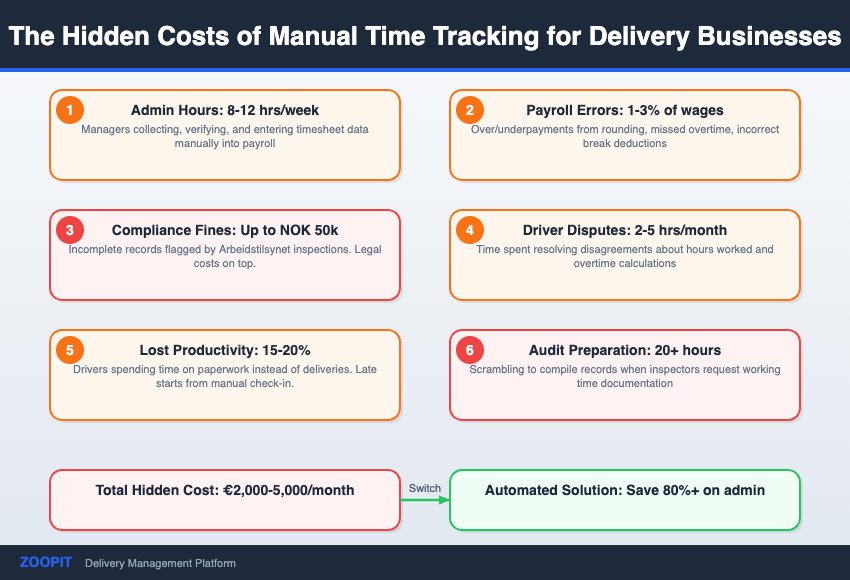
Manual time tracking seems simple enough. Drivers write down when they started, when they finished, and submit their hours. But in practice, this process introduces several costly problems that most managers do not see until they look at the numbers.
The first cost is inaccuracy. Research consistently shows that people are poor at estimating time after the fact. A driver who finished at 16:42 will write 17:00. A late start gets forgotten. Over a month, these small rounding errors compound into hours of overpayment or underpayment per driver. For a company with 20 drivers, even 15 minutes of daily rounding error per driver adds up to over 100 hours per month of inaccurate time data.
The second cost is administrative overhead. Someone has to collect the paper logs or spreadsheets, verify them against route data, resolve discrepancies, and enter the numbers into the payroll system. For most delivery companies, this process takes several hours per week. That is time your operations team could spend on scheduling, customer service, or improving ruttoptimering.
The third cost is disputes. When time records are based on memory and manual entry, disagreements between drivers and managers are inevitable. These disputes damage trust, take time to resolve, and occasionally escalate into formal complaints or even legal action. In Norway, employers are legally required to maintain accurate records of working hours under the Working Environment Act, and manual records are difficult to defend in an inspection.
What the Numbers Actually Look Like
Consider a delivery company with 25 drivers. With manual time tracking, assume each driver’s recorded hours are off by an average of 12 minutes per day. That is one hour per week per driver, or 25 hours per week across the fleet. At a cost of 250 NOK per hour, that is 6,250 NOK per week in payroll inaccuracy alone — over 325,000 NOK per year.
Add the administrative time to process manual logs: perhaps 5 hours per week for someone earning 350 NOK per hour. That is another 91,000 NOK per year. Then factor in the occasional payroll dispute that takes a manager half a day to resolve, and the total cost of manual time tracking easily exceeds 450,000 NOK annually for a mid-sized delivery operation.
These are conservative estimates. Companies with more drivers, higher hourly rates, or complex shift patterns will see even larger numbers. The irony is that most companies never calculate these costs because they are distributed across payroll, operations, and HR budgets rather than appearing as a single line item.
What Automatic Time Tracking Changes
Replacing manual time tracking with an automatic system eliminates most of these costs immediately. When drivers tap to start and stop their shifts in an app like the Zoopit Time Tracker, every minute is recorded precisely. There is no rounding, no forgetting, and no room for interpretation.
The administrative burden drops dramatically. Instead of collecting and verifying paper logs, managers can export accurate time reports directly from the dashboard. Payroll processing that used to take hours takes minutes. Disputes virtually disappear because both drivers and managers are looking at the same objective data.
For companies operating under Norwegian labour law, automatic tracking also simplifies compliance. The system maintains a complete, auditable record of every driver’s working hours, breaks, and overtime. This is exactly what the Labour Inspection Authority expects during an audit, and it is far more reliable than paper records.
The Zoopit fleet management platform integrates time tracking with route data, so managers can also correlate working hours with delivery performance. This provides insights that are simply impossible with manual tracking, such as identifying which routes consistently run over time or which shifts have the most overtime.
Research from Harvard Business Review shows that companies using manual time tracking methods lose an average of 5-7 hours per employee per month to administrative overhead and corrections.
The Fastest Way to Switch
Moving away from manual time tracking does not require a long implementation project. The Zoopit Time Tracker can be set up in minutes, and most drivers learn the one-tap interface in their first shift. There is no training required, no hardware to install, and no complex configuration.
If you want to see how much manual time tracking is costing your specific operation, visit our Time Tracking page to request a demo and get a personalized cost analysis. The savings almost always pay for the solution many times over.
Stop Losing Money on Manual Time Tracking
Zoopit’s Time Tracker pays for itself in weeks, not months. Automatic hour logging eliminates payroll disputes, reduces admin time by 80%, and gives you audit-ready compliance records without anyone touching a spreadsheet.
Book a free demo and we’ll calculate the real cost savings for your fleet size. Most customers are surprised by how much manual tracking actually costs them.
See the full Zoopit platform to understand how time tracking fits into the bigger picture.