
A thorough delivery management software comparison is one of the most impactful steps a logistics team can take. The right platform streamlines your entire delivery operation — from order intake to proof of delivery. The wrong one creates friction, frustration, and wasted budget. This guide helps you understand what to compare, what questions to ask, and how to find the solution that fits your operation across the Nordics and beyond.
What Delivery Management Software Should Cover
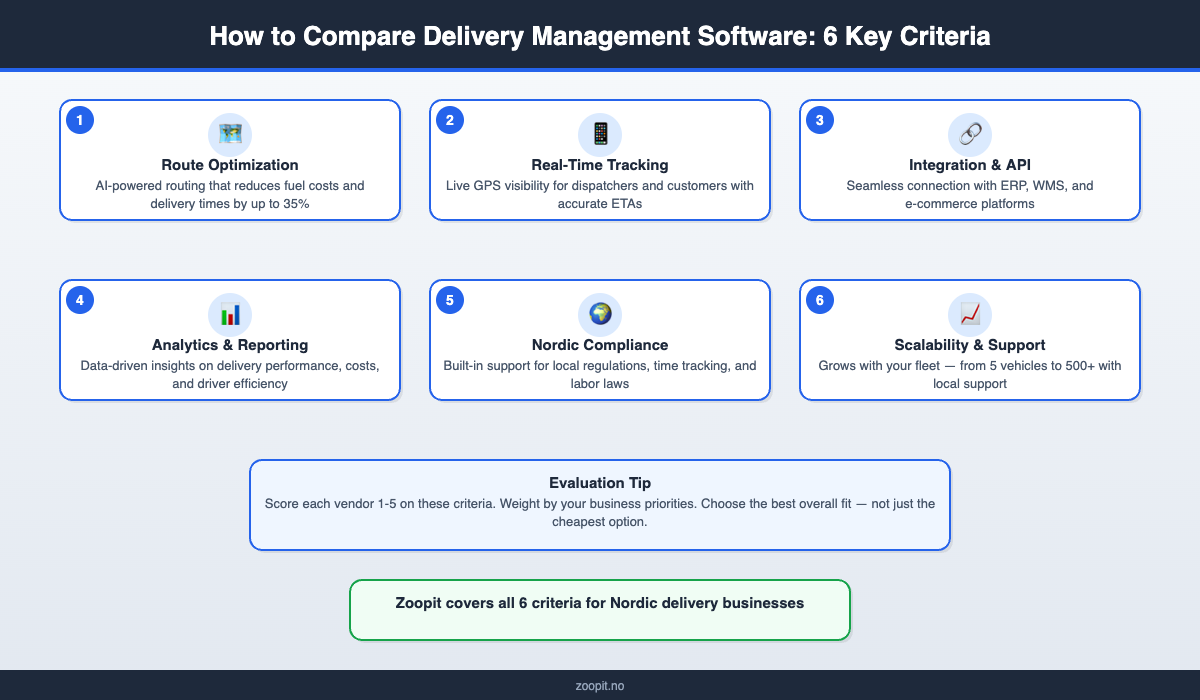
A complete delivery management platform handles the full delivery lifecycle: order import and dispatch, route optimization, driver management and communication, real-time GPS tracking, proof of delivery, return handling, and reporting. Some platforms focus on just one piece of this chain — route optimization only, or tracking only. For most delivery operations, a unified platform that covers the entire workflow delivers far more value than stitching together separate point solutions. The API should be the backbone of the platform, covering order management, route planning, notifications, GPS tracking, and resource administration in a single integrated system.
Key Factors to Compare
Planning Capabilities: Tactical and Operational
The most important differentiator between delivery management platforms is planning depth. Basic platforms handle operational planning — routing today’s orders onto today’s vehicles. Leading platforms also offer tactical planning: the ability to model and simulate optimal route networks using customer data, fleet information, and delivery contracts before orders are placed. Tactical planning answers strategic questions like optimal fleet composition, ideal delivery windows per customer, and what-if scenarios for fleet changes (e.g., switching diesel vehicles to electric). This capability is rare but transformative for operations planning.
Route Optimization Depth
All delivery management platforms claim route optimization, but the depth varies enormously. Evaluate whether the platform handles real constraints: vehicle type matching (height, weight, capacity, fuel type, electric range), customer time windows, driver working hours and rest regulations, and operational details like loading dock restrictions. The best platforms support both manual planning (select orders, choose vehicles, fine-tune) and automatic planning (rules-based route generation at scheduled times), plus the ability to adjust routes after generation with drag-and-drop editing, merging, and splitting.
Driver App Quality
The driver app is where the platform meets reality. Test it thoroughly: does it cover the complete delivery workflow in one app? This means route navigation, item scanning with multi-barcode support and manifest validation, configurable proof of delivery (photo, signature, scan — set per customer or order), exception reporting, return and carrier equipment tracking, and custom forms. The app should provide GPS positions for live tracking and ETA calculations, work reliably on both iOS and Android, and send alerts if a driver has not started their route. If your drivers need a separate app for scanning, another for navigation, and a third for PoD, you have already lost.
Ad-Hoc Order Handling
No delivery day goes exactly as planned. Evaluate how each platform handles express and ad-hoc orders. Can orders be received via API in real time? Can they be assigned to existing routes automatically based on rules, or manually by the dispatcher? Does each stop support multiple tasks — delivery, pickup, return — with real-time updates to the driver? Can the system flag unallocated orders so nothing is missed? Platforms that treat ad-hoc orders as an afterthought will cost you in missed deliveries and dispatcher stress.
Integration Architecture
Your delivery software needs to work with your existing systems — ERP, warehouse management, e-commerce platforms, and carrier networks. Evaluate both the API breadth (does it cover orders, routes, users, notifications, GPS, and resources?) and the integration approach (webhooks for real-time event-driven data exchange, or batch imports?). Webhook support that triggers on defined events and supports custom event subscriptions is essential for keeping systems synchronized. Check API authentication (bearer tokens with role-based access), documentation quality, and whether you can set up integrations yourself or need vendor consultants.
Nordic and European Compliance
If you operate in Norway, Sweden, Denmark, or the UK, your software needs to handle local requirements: GDPR data processing with proper encryption (SSL/TLS in transit, encrypted at rest), EU driving and rest time regulations for drivers, local language support, European mapping and geocoding accuracy, and integration with regional carrier networks. A platform built for the US market may technically work, but it will miss important compliance details that affect your daily operations and legal obligations.
Scalability and Configuration Flexibility
Delivery volumes fluctuate seasonally and grow over time. The platform should scale without dramatic cost increases or architectural changes. But scalability is not just about volume — it is about configuration flexibility. The best SaaS platforms are built so that two different customers can use the same system in completely different ways, each configured for their specific workflows through APIs and user interfaces rather than custom development. This means you get a standard, continuously updated product while maintaining your unique operational processes and competitive advantages.
Questions to Ask Every Vendor
When evaluating delivery management platforms, ask these questions to every vendor on your shortlist. How long does implementation typically take? (Best-in-class: 12-16 weeks to full production.) Can we run a pilot with our actual delivery data? Do you support both tactical and operational planning? How does your driver app handle proof of delivery, scanning, and returns? What does your API cover and do you support webhooks? Can we configure different delivery workflows per customer without custom development? What does your customer support look like after go-live? How do you handle data migration from our current system?
How to Run an Effective Evaluation
Start with a clear requirements document listing your must-have features, nice-to-have features, and deal-breakers. Shortlist 3-4 vendors maximum — more than that creates decision paralysis. Request a pilot or proof of concept using your real delivery data, not a generic demo with fake addresses. Involve your dispatchers and at least one driver in the evaluation — they will catch usability issues that management demos miss. Test the full workflow: order import, route optimization, dispatch to driver app, delivery execution with PoD, and reporting.
A Gartner market overview highlights that Nordic businesses face unique delivery management challenges including seasonal darkness, rural distances, and strict EU compliance requirements. Any delivery management software comparison for this region must weight these factors heavily alongside standard feature evaluations.
A thorough delivery management software comparison takes time, but it pays off. The platform you choose will shape your delivery operations for years. Use the criteria in this delivery management software comparison as your evaluation framework, and involve both your planning team and drivers in the assessment process — they’ll spot practical issues that no feature list can reveal.
Making the Final Decision
The best delivery management software is the one your team actually uses every day. Technical capabilities matter, but so do ease of use, vendor responsiveness, and implementation support. Choose the platform that solves your biggest pain points today while having the depth to grow with you — from basic route optimization to tactical planning, AI-assisted operations, and advanced analytics. And remember — the cost of inaction is real. Every month spent on manual processes or fragmented tools is a month of higher costs, more failed deliveries, and missed opportunities to improve.
A reliable delivery management software comparison should go beyond feature checklists. The best approach is to test platforms with your actual delivery data, evaluate driver app usability in the field, and compare total cost of ownership over 24 months. This delivery management software comparison guide gives you the framework to make a confident decision for your Nordic operation.
Want to See How Zoopit Compares?
We built Zoopit specifically for Nordic delivery operations — with EU compliance, multi-language support, and the planning depth that Nordic logistics teams need. From tactical masterplan simulation to real-time operational execution, Zoopit covers the full delivery workflow.
Book a free demo and evaluate Zoopit against your current criteria. We’ll show you exactly how our platform handles your specific use cases — no generic sales deck.
Explore the full Zoopit solution to see all modules and integrations.