
Many delivery companies still plan routes manually — using local knowledge, gut feeling, and spreadsheets. It works, until it does not. As delivery volumes grow and customer expectations tighten, the gap between manual planning and automated route optimization becomes a serious competitive disadvantage. This article breaks down the real costs of both approaches so you can make an informed decision.
What Manual Route Planning Actually Costs
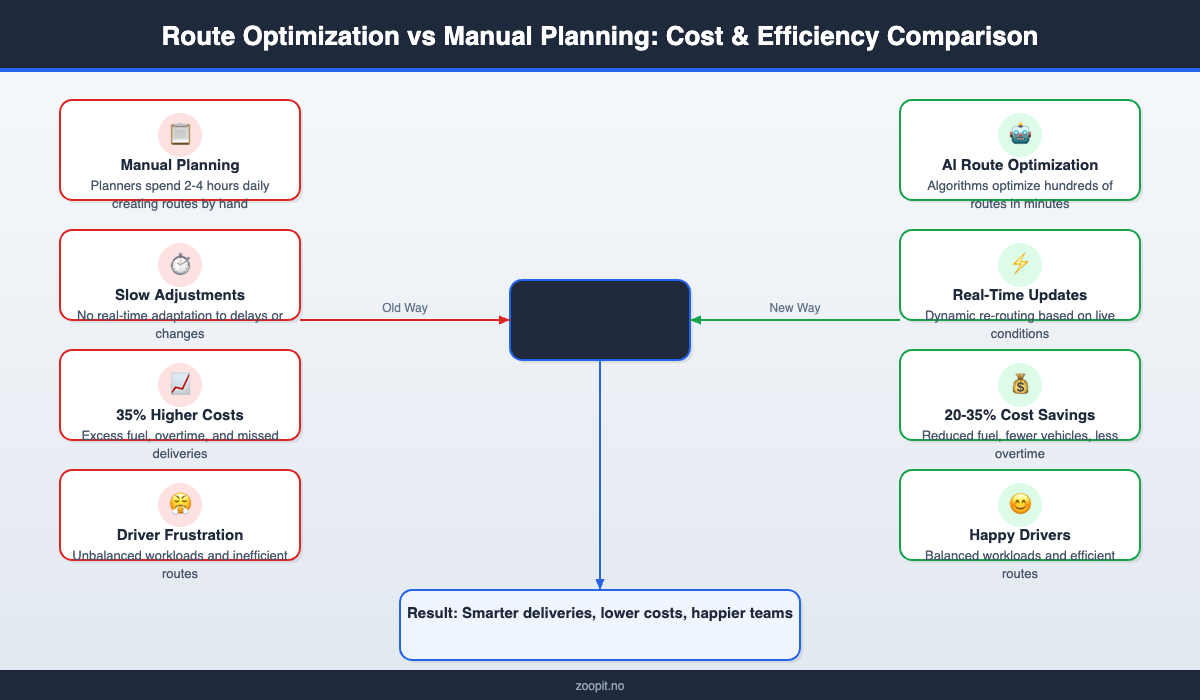
Manual planning looks cheap on the surface because there is no software to buy. But the hidden costs add up fast. A dispatcher spending 2-3 hours each morning building routes is 2-3 hours of salary spent on a task that software can do in minutes. More importantly, human-planned routes are typically 15-25% longer than optimized routes — meaning more fuel, more driving hours, and fewer deliveries per driver per day.
Consider a fleet of 10 drivers making 150 deliveries per day. If manual routes add just 20 minutes of unnecessary driving per driver, that is over 3 hours of wasted driving time daily across the fleet. At average European fuel and labor costs, that is roughly €200-400 per day in avoidable expenses — or €50,000-100,000 per year.
What Route Optimization Software Delivers
Route optimization software considers hundreds of variables simultaneously: traffic patterns, delivery time windows, vehicle capacity and type, driver working hours, road restrictions, electric vehicle range, and customer priorities. No human planner can process this many constraints at once, especially under time pressure at 6 AM when routes need to be ready before drivers arrive.
The results are consistently measurable. Companies switching from manual to optimized planning typically see 20-30% reduction in total driving distance, 15-25% more deliveries per driver per day, 30-50% less time spent on daily planning, and significantly fewer late deliveries and missed time windows.
Beyond Basic Routing: Constraint-Based Optimization
Basic route optimization plots the shortest path between stops. Advanced platforms go much further by matching orders to vehicles based on real operational constraints. This means the system automatically considers details like whether a delivery requires a vehicle below a certain height for an underground loading dock, whether the axle weight limit at a delivery point restricts which trucks can go there, or whether an electric vehicle has enough range for a specific route. In manual planning, dispatchers carry this knowledge in their heads — and when that dispatcher is absent, the knowledge walks out the door. Constraint-based optimization makes these rules systematic and reliable.
Manual vs Automatic Planning Modes
Good route optimization software does not force you to go fully automatic from day one. The best platforms support multiple planning modes. Manual planning lets you select specific orders, choose your vehicles, set your priorities, and fine-tune the results — giving experienced dispatchers control while the algorithm handles the heavy lifting. Automatic planning generates routes at scheduled times based on pre-configured rules, which is ideal for operations with fixed cut-off times and high order volumes. And hybrid approaches let you start with automatic routes and then adjust, merge, split, or reassign stops using drag-and-drop before dispatching.
The Hidden Costs of “Good Enough” Planning
One argument for manual planning is that experienced dispatchers “know the routes.” And they do — for today’s conditions with today’s customers. But what happens when that dispatcher is sick, on holiday, or leaves the company? Manual planning creates a single point of failure. All the route knowledge lives in one person’s head, and it walks out the door with them.
Route optimization software makes planning institutional rather than personal. Any team member can generate efficient routes in minutes, new drivers get optimized navigation from day one, and the system improves over time as it processes more delivery data. The platform also maintains operational details — vehicle constraints, customer delivery requirements, access restrictions — that would otherwise exist only in a dispatcher’s memory.
Tactical Planning: The Strategic Advantage Manual Planning Cannot Match
Beyond daily route optimization, leading platforms offer tactical planning — the ability to model and simulate optimal route networks before orders exist. Using customer data, fleet information, and delivery contracts, tactical planning answers strategic questions: What is the ideal fleet composition? What delivery windows should you offer each customer? What happens to costs if you switch from diesel to electric vehicles on certain routes? Manual planning cannot answer these questions because it only deals with today’s orders. Tactical planning gives you the data to make better long-term decisions about fleet investment, carrier contracts, and customer service levels.
When to Make the Switch
If you are running fewer than 3 vehicles with predictable, repeating routes, manual planning may still work. But once you hit 5 or more vehicles, variable delivery points, or customer time windows, the math strongly favors optimization software. The return on investment typically arrives within 2-4 months through fuel savings and increased delivery capacity alone. Implementation timelines for modern SaaS platforms are typically 12-16 weeks from kickoff to full production, with initial route optimization often running within the first few weeks.
A Supply Chain Dive analysis shows that route planning inefficiencies account for up to 30% of unnecessary delivery costs. When comparing route optimization vs manual planning, the gap widens further as fleet sizes grow beyond 10 vehicles — the point where spreadsheet-based planning simply cannot account for all variables.
The route optimization vs manual planning debate ultimately comes down to scalability and accuracy. Manual planning may work with 3-5 drivers, but route optimization vs manual planning comparisons consistently show that automated solutions deliver 15-25% efficiency gains. For growing delivery operations, the switch from manual to optimized planning is not a question of if, but when.
Making the Transition
Switching from manual to automated planning does not have to be all-or-nothing. Many companies start by running the software alongside their manual process for a week, comparing the routes side by side. When dispatchers see the software consistently producing shorter routes with better time window compliance, adoption follows naturally. The key is choosing software that supports both manual and automatic modes — so your team can transition gradually, keeping full control while learning to trust the optimizer. A platform like Zoopit lets planners start in manual mode, move to hybrid planning, and eventually automate daily route generation as confidence grows.
The choice between route optimization vs manual planning ultimately comes down to scale and ambition. Small operations with 2-3 vehicles may survive with manual planning, but any fleet beyond that pays a steep hidden tax. When you compare route optimization vs manual planning on a 12-month basis, the automated approach typically pays for itself within 60 days. Fleet managers who have switched from manual planning to route optimization report that the transition itself takes less than two weeks, making route optimization vs manual planning one of the easiest technology upgrades in logistics.
Ready to Move Beyond Spreadsheet Planning?
Zoopit gives you the best of both worlds: powerful automatic route optimization when you need speed, and full manual control when you need flexibility. Our hybrid planning mode lets your team override, adjust, and fine-tune routes — so you get algorithmic efficiency without losing human judgment.
Book a free demo and see the real cost difference for your operation. We’ll run a side-by-side comparison using your actual delivery data.
Explore our programvare for ruteoptimalisering to learn more about how it works.