
Fleet management software has evolved from simple vehicle tracking into a comprehensive operations platform. In 2026, the best fleet management tools do far more than show dots on a map — they help you plan smarter, dispatch faster, and give you full control over your delivery or service operations. Whether you are managing 10 vans or 500 trucks, choosing the right platform can transform how your fleet performs. Here is what to prioritize.
What Fleet Management Software Actually Does
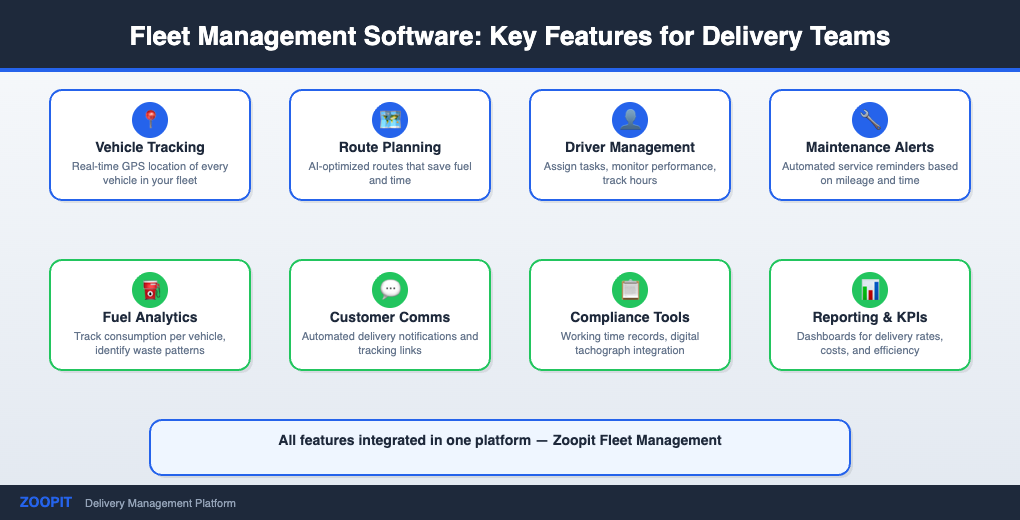
At its core, programvare for flåtestyring gives you visibility and control over your vehicles, drivers, and operations. This includes real-time vehicle tracking, driver assignment and scheduling, vehicle and resource administration, constraint management, compliance monitoring, and performance analytics. The best platforms integrate these functions into a single dashboard rather than requiring you to switch between multiple tools. The key differentiator in 2026 is not whether the software tracks vehicles — that is table stakes — but how deeply it connects fleet data to planning, dispatch, and delivery operations.
Must-Have Features for Delivery Fleets
If your fleet primarily handles deliveries, whether B2C e-commerce, B2B distribution, or food and grocery — you need fleet management that goes well beyond basic tracking. Here are the features that matter most for delivery-focused operations.
Vehicle and Resource Profiles With Real Constraints
Knowing where every vehicle is at any moment is just the beginning. Truly useful fleet management means maintaining detailed vehicle profiles — vehicle type, capacity, fuel type, electric range, height restrictions, and weight limits. When these profiles are connected to your route optimization, the system automatically matches orders to compatible vehicles. For example, a delivery to an underground garage with a 2-meter height restriction is automatically assigned to a suitable vehicle, not left to the dispatcher’s memory. This constraint-based matching prevents mismatches that cause failed deliveries and wasted trips.
Driver Management With Working-Time Compliance
Managing driver hours, skills, vehicle certifications, and break requirements manually is error-prone and time-consuming. Good fleet management software handles these constraints automatically, including driving and rest time regulations for transport companies operating under EU rules. The system should ensure the right driver is assigned to the right vehicle and the right route, every time, while staying within legal working-time limits. For fleets using multiple carriers or subcontractors, the platform should also manage carrier-level resource allocation and availability.
Dynamic Dispatch and Real-Time Reallocation
Delivery operations rarely go exactly as planned. A driver calls in sick, a customer reschedules, an urgent order comes in mid-day. Your fleet management software should make it easy to reassign stops, adjust routes, and rebalance workloads in real time without starting from scratch. Look for features like drag-and-drop route editing, the ability to merge or split routes, and automatic assignment of ad-hoc orders based on current driver locations and remaining capacity. The system should also flag unallocated orders so nothing falls through the cracks.
Multi-Task Stop Support
Real delivery operations are not just about dropping off packages. Each stop may involve multiple tasks — delivery, pickup, returns, carrier equipment exchange, or form completion. Your fleet management platform should support multi-task stops where each task has its own status, scanning requirements, and documentation workflow. This is especially important for industries like food distribution, where a single stop might include delivering fresh goods, picking up returns, and exchanging carriers — all tracked separately in the driver app.
Analytics and KPI Reporting
You cannot improve what you do not measure. Look for software that provides clear dashboards showing deliveries per driver, on-time performance, cost per delivery, fuel consumption trends, and fleet utilization rates. The best tools let you export data to your existing analytics stack — connecting to platforms like PowerBI for deeper analysis. Real-time dashboards for transport managers give operational visibility, while exportable KPI data supports strategic decision-making at the management level.
The Driver App as Fleet Management Tool
A fleet management platform is only as good as its connection to the road. The driver app is where fleet data becomes operational reality. Look for an app that covers the complete workflow: route following with turn-by-turn navigation, item scanning with multi-barcode support (including validation against the manifest), proof of delivery capture, exception reporting, and return or carrier tracking. The app should send GPS positions back to the platform in real time, enabling live ETA calculations and real-time fleet visibility. If a driver has not started their route, the system should notify the transport manager automatically.
API-First Architecture for Integration
Fleet management software does not operate in isolation. It needs to connect with your order management system, ERP, warehouse management, and potentially your customers’ systems. Prioritize platforms built with an API-first architecture, where the API is not an afterthought but the backbone of the entire system. Look for comprehensive API coverage across orders, routes, user accounts, notifications, GPS, and resources — secured with bearer authentication and role-based access. Webhook support for real-time event-driven integrations is essential for keeping all your systems in sync without batch processing delays.
Cloud-Based SaaS: The Standard in 2026
In 2026, the vast majority of fleet management solutions are cloud-based SaaS platforms — and for good reason. Cloud platforms offer faster deployment, automatic updates, lower upfront costs, and access from any device. Scalable SaaS platforms can handle everything from small local fleets to high-volume national distribution operations without infrastructure changes. The platform’s flexibility should mean that two different customers can use the same software in completely different ways, configured for their specific workflows, while running on the same standard codebase.
According to Grand View Research, the global fleet management software market is projected to grow at 10.6% CAGR through 2030. This growth reflects how critical fleet management software has become for delivery operations seeking to control costs while meeting rising customer expectations.
Choosing the right fleet management software requires looking beyond feature lists. The best fleet management software platforms integrate seamlessly with your existing systems through robust APIs, support your specific vehicle types and constraints, and scale with your business. Fleet management software that combines planning, execution, and analytics in one platform eliminates data silos and gives operations teams a single source of truth.
Choosing the Right Platform
Start by documenting your top three operational pain points — these should drive your evaluation criteria. Request demos using your actual data and routes, not generic examples. Talk to references in your industry and of a similar fleet size. And pay close attention to the implementation experience: the best platforms can get you from kickoff to full production in 12-16 weeks, starting with basic route operations and progressively enabling advanced features like tactical planning, automated route generation, and KPI reporting. A delivery management platform that feels like a simple, intuitive tool for every user in the logistics chain — from planner to driver to manager — is the one that will actually get adopted.
Looking for Fleet Management Software That Actually Fits Delivery Operations?
Zoopit isn’t generic fleet tracking — it’s purpose-built for delivery. From vehicle constraint profiles and driver working-time compliance to multi-task stops and real-time ETA updates, every feature is designed for teams that deliver goods to customers every day.
Book a free demo and see how Zoopit manages your fleet, routes, and drivers in one platform. We’ll tailor the walkthrough to your fleet size and delivery types.
Start with our fleet management overview to see what’s included.