
Failed deliveries cost logistics companies millions every year — not just in redelivery expenses, but in lost customer trust and wasted driver time. Industry data shows that 5-10% of all deliveries fail on the first attempt, and each failed delivery can cost between €12-20 to reattempt. The good news: companies using modern delivery management tools are cutting their failure rates by 30-40%. Here is how they do it.
Why Deliveries Fail
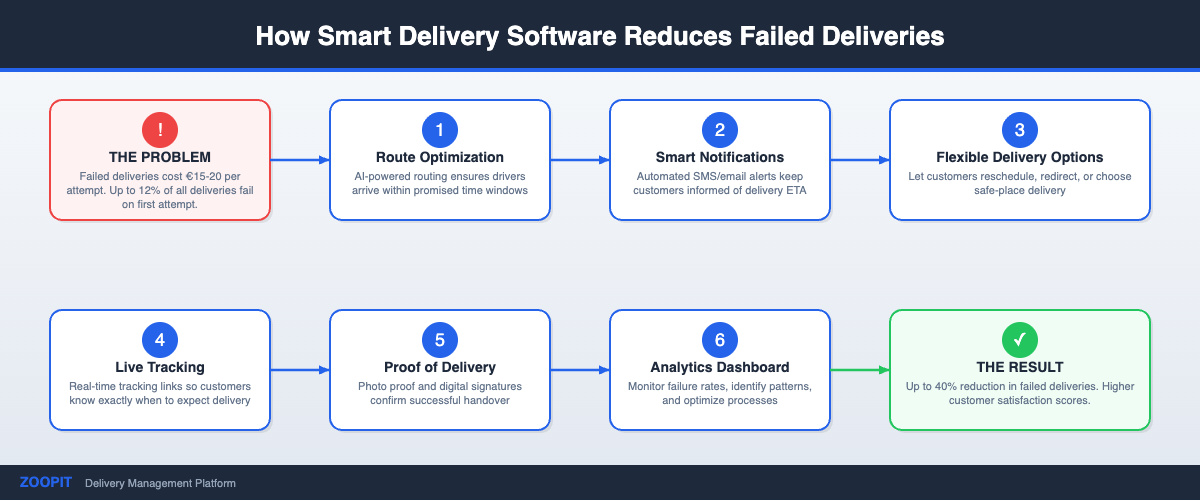
Before you can fix failed deliveries, you need to understand why they happen. The most common reasons are surprisingly consistent across industries: the customer is not home, the address is wrong or incomplete, the delivery window was missed, or the driver could not find the location. In many cases, these failures are preventable with better planning and communication.
Strategy 1: Accurate Delivery Time Windows Through Smart Route Optimization
The single biggest reason for failed deliveries is that the customer is not available. When you can give customers a precise 1-2 hour delivery window instead of a vague “sometime today,” the chance they will be home increases dramatically. This starts with software de optimización de rutas that calculates realistic ETAs based on actual driving conditions, stop sequences, service times, and vehicle constraints — not guesswork. The best platforms take this further by supporting tactical planning, where you can model optimal delivery windows per customer based on historical data, contracts, and delivery frequencies before orders are even placed.
Strategy 2: Real-Time Customer Notifications
Automated SMS and email notifications at key stages — order dispatched, driver en route, 15 minutes away — keep customers informed and prepared. When customers know exactly when to expect their delivery, they make arrangements to be available. Look for platforms with configurable notification systems that can be set up via webhooks or a built-in notification module with custom triggers. The ability to configure different notification rules per customer or order type (rather than sending the same message to everyone) makes a significant difference in reducing no-shows.
Strategy 3: Address Validation and Delivery-Point Details
Wrong or incomplete addresses account for a significant share of failed deliveries. Modern delivery software validates addresses at the point of order entry and geocodes them to precise GPS coordinates. But address accuracy is only part of the picture. Leading platforms let you store delivery-point details like loading dock specifications, height restrictions, access codes, and opening hours. When this information flows through from order to route to driver app, your drivers arrive prepared — no wasted time searching for entrances or discovering they brought the wrong vehicle type.
Strategy 4: Proof of Delivery and Real-Time Exception Handling
When a delivery cannot be completed, what happens next matters enormously. Digital comprobante de entrega systems let drivers document the situation in real time — photo of the location, note about why delivery failed, barcode scan of items attempted. Instead of finding out about a failed delivery hours later from a paper manifest, your dispatch team knows immediately and can reroute or reschedule within minutes. The best systems support configurable PoD workflows per customer: some may require photo evidence and a signature, while others just need a confirmation scan. Multi-scan capabilities that verify every item against the order prevent partial deliveries and wrong-item scenarios.
Strategy 5: Data-Driven Route Planning With Constraint Matching
Route optimization that accounts for traffic patterns, delivery priorities, and historical success rates for specific addresses or time slots can dramatically reduce failure rates. But the real game-changer is constraint-based planning — where the system automatically matches orders to vehicles and drivers based on compatibility. For example, if a delivery requires a vehicle with a loading ramp under 2 meters or an axle weight under 2 tonnes, the route optimizer should handle this automatically rather than relying on dispatchers to remember these details. When every delivery is assigned to the right vehicle with the right capabilities, mechanical failure-to-deliver drops to near zero.
Strategy 6: Handle Ad-Hoc Orders Without Disrupting Existing Routes
Many failed deliveries happen when last-minute orders are added to already-packed routes. The dispatcher squeezes in an extra stop, the driver runs late, and the last three customers on the route miss their windows. A proper delivery management platform handles ad-hoc and express orders differently: new orders can be received via API or created directly, then assigned to routes based on pre-configured rules — factoring in current driver locations, remaining capacity, and time windows. Each new stop can include multiple tasks (delivery, pickup, return) with instant updates to the driver app.
Research from Capgemini’s last mile delivery report confirms that failed deliveries cost European retailers an average of €14.69 per parcel. For businesses handling thousands of deliveries daily, the ability to reduce failed deliveries directly impacts profitability and customer retention.
The strategies above work together as a system. Companies that reduce failed deliveries successfully don’t rely on a single fix — they combine smart routing, proactive communication, and flexible delivery options. The goal isn’t just to reduce failed deliveries once, but to build processes that keep failure rates consistently low as your delivery volume grows.
The Compound Effect
Each of these strategies delivers incremental improvement on its own, but the real gains come when they work together as part of an integrated plataforma de gestión de la entrega. Companies that combine optimized routing with constraint matching, proactive customer notifications, address validation with delivery-point details, configurable proof of delivery, and smart ad-hoc order handling typically see their failure rates drop by 30-40% within the first three months. For a company making 500 deliveries per day, that translates to 15-20 fewer failed deliveries daily — saving thousands in redelivery costs every month.
Companies that invest in modern delivery technology consistently reduce failed deliveries across their operations. Whether you operate in Norway, Sweden, Denmark, or the UK, the strategies to reduce failed deliveries remain the same: better routing, proactive communication, and flexible options for recipients. The data is clear — businesses that reduce failed deliveries see measurable improvements in customer retention and operational margins within the first quarter of implementation.
Want to See Your Failed Delivery Rate Drop?
Zoopit customers typically see a 30-40% reduction in failed deliveries within the first three months. Our platform combines constraint-based routing, real-time customer notifications, and configurable proof of delivery — so packages reach the right person, at the right time, every time.
Reserve una demostración gratuita and we’ll show you exactly how these strategies work in practice with your delivery data.
Want to learn more first? See how our optimización de rutas and comprobante de entrega features work together.